Showing posts with label theology. Show all posts

Tuesday, July 18, 2023

The Theology of a Cadaver?

In my capacity as a Chaplain for the Seminole County Fire Department, it’s often a privilege to be present when personnel are training, honing the skills they need for any given call and emergency. Such training can include everything from hose and hydrant drills to high angle rescue, to medic emergency procedures. For paramedic practices, various dummies have been manufactured to help train personnel for protocols in CPR and airway intubation, and everything in between. These synthetic dummies, however, cannot replace the value of practice on the “real thing”: the human body.

This presents a challenge for designing training. How much of that can be practiced on a live volunteer? People might willingly be dragged across smooth floor, lifted into a rescue basket, or have their “broken” leg splinted, but they won’t agree to be intubated (airway tube), shocked (AED) or have someone practice drilling into their bones. For those later exercises, willing people have willed that their bodies be donated to science; and for purposes of the medic training, that resulted in the “Cadaver Lab.”

As chaplain, such moments make me question just how much of the fire department’s training do I really want to attend. On the surface, it seemed unwise, but brave the Cadaver Lab I did, and I’m now grateful to have been included. What’s more? I think that such training resources like the Cadaver Lab need to be incorporated into a theology of the body that permeates Christianity.

I’d like to offer a different take on the concept taught among Christians that comes from the book of 1st Corinthians. “Or do you not know that your body is the temple of the Holy Spirit who is in you, whom you have from God, and you are not your own? For you were bought at a price. Therefore glorify God with your body” (1 Cor. 6:19-20, NET). The context of this statement was the Apostle Paul’s admonition for the reader to abstain from sexual immorality, arguing that there’s no such thing as a “victimless crime;” that sexual sins violate the mandate of your design, and the intent of your body’s rightful owner…God.

This concept of the body as “God’s temple” has, in some circles, been expanded to prohibit other vices indulged with the body as well (i.e. gluttony, drunkenness, and some have gone on to apply to it smoking as well). In any event, the “body as God’s temple” concept has been applied to encourage abstinence; abstaining from sexual sins or any other vice that debases one’s own body from its intended dignity and purpose. This is a good and right message, and one sorely needed in a culture that indulges every appetite and whim.

The discipline of abstaining, however, is only half the message. Studying the spiritual disciplines intended for Lent (the penitential season that precedes Easter in the Christian calendar) will lead you to authors such as Richard Foster and Dallas Willard, who have written about both the abstaining AND engaging disciplines. Abstaining disciplines offer categories of things to DON’T do, while engaging disciplines point toward things to DO. On the one hand, examples of abstaining disciplines are things like fasting, silence, solitude, and frugality. On the other hand, examples of engaging disciplines include things like generosity, fellowship, or study. Some will think that this is a stretch, but I think the complementary categories of abstaining and engaging disciplines also can be applied to the “body as God’s temple” concept.

If there are things to NOT do with “God’s temple,” surely there are things to DO with God’s temple as well. This seems to me an important teaching that, while lacking a clear Bible verse as its referent, permeates the Christian notion of service. The manner in which you serve the purposes of God are all done in the body. In other words, every way you serve God you do so with “God’s temple.” When you show appropriate affection to a loved one, you assure them of their value using “God’s temple.” When you carry a heavy load for someone moving boxes, you serve them with “God’s temple.” Likewise, when you give blood in times of need, you offer life-giving assistance using “God’s temple.”

Imagine offering, in your last will and testament, “God’s temple” for the furtherance of life-saving knowledge for firefighters, paramedics and nurses in training.
That is what these people did who gave their bodies for the Cadaver Lab. The instructor took a moment of silence at the beginning of the class to honor those that had donated their bodies for the lab, which I found to be an appropriate and fitting homage. It seemed to me, though, that a Christian perspective can go even further.

As with an organ donor, upon death the body is donated to give life. As for things to DO with “God’s temple” (as opposed to things NOT to do), I can think of few more praiseworthy uses for “God’s temple.” Were any of the people, whose body helped to teach medic procedures, Christians? I have no idea, and it holds no bearing on the nobility of their choice. I do think, however, that Christians, having been taught the “body as God’s temple” concept, should be particularly open to such final acts of service. As one’s final choice with what to do with their body, surely advancing knowledge and giving life should be high on the list of things to do with “the temple of the Holy Spirit.”

Monday, May 24, 2021

Without Wind, There is No Flight

aerodynamics - Is the airspeed different between above and ...

Come Holy Spirit, heav'nly Dove,     
    With all thy quick'ning powers; 
Kindle a flame of sacred love 
    In these cold hearts of ours. 

See how we trifle here below, 
    Fond of these earthly toys: 
Our souls, how heavily they go, 
    To reach eternal joys. 

In vain we tune our formal songs, 
    In vain we strive to rise: 
Hosannas languish on our tongues, 
    And our devotion dies. 

Come, Holy Spirit, heav'nly Dove, 
    With all thy quick'ning powers; 
Come, shed abroad a Saviour's love, 
    And that shall kindle ours.    Amen. 

Hymn# 369: Hymnal 1940 

    One of the more interesting things I learned from getting a drone pilot's license was having to know how actual aircraft work. To pass the exam to achieve a commercial license to operate an small Unmanned Aerial Vehicle (UAV), you had to learn about much that normal pilots of manned aircraft have to know. Details such as weather patterns, navigation, and airspace regulations (particularly important) were among the required knowledge, but so was something seemingly less applicable to small droves: airspeed. 

    Fixed-wing aircraft achieve flight because air passes over and under their wings at such a speed to produce lift. The airspeed is the speed with which the air is flowing over and under the wings and doesn't correspond directly to ground speed. An aircraft with a headwind might have an airspeed that is significantly greater than how fast they are traveling from point A to point B. For this reason, a strong tailwind can undermine the aircraft's ability to even stay in the air. A phenomenon known as "wind sheer" can abruptly reduce the aircraft's airspeed, causing it to stall and fall out of the sky. Airspeed, not ground speed, is what enables the aircraft to take off from the ground and stay in the air once it's up. 

    Without airspeed, the aircraft is not an aircraft at all. It's instead (at best) a rather awkward and inefficient vehicle for driving (taxiing) from one end of the airport to another, or (at worst) a harmful object falling out of the sky. It's certainly not able to operate as designed: as an aircraft. 

    Such is the case for the Christian, who can be likened to an aircraft. The Christian has a design, a purpose, and function in the world, and requires the enablement of "wind" in order to achieve that function. Now many sermons have been given before about the "wind" that blew through the room where the Apostle's were gathered together in Acts 2:2. These are often a bit awkward since the texts says "Suddenly a sound like a violent wind blowing came from heaven and filled the entire house where they were sitting" (NET). Nevertheless, while Acts 2 emphasizes the "sound" of a mighty wind, rather than the wind itself, other passages associate the Spirit of God with a "wind" that passes over the primordial Creation (Gen 1:2), or that is "breathed out" by Christ onto his disciples (John 20:22). Such is the association of the Spirit of God with "breath" and "wind" that we categorize our study of the Doctrine of the Holy Spirit as "Pneumatology." (pneuma = Greek for "breath" or "spirit"). 

    So the analogy of wind to describe the movement of the Spirit of God is not only reasonable, but frequent in the Scriptures. For this reason, this last Sunday as we sang Hymn #369 for the Pentecost, it occurred to me that Isaac Watts was describing the operation of an aircraft. Without the airspeed provided by the Divine "wind," the aircraft (worshipper/Christian) doesn't get off the ground at all. The two center verses describe with glaring theological accuracy the complete inability to worship as we ought to, function as we must, or accomplish anything for which we are designed without the enablement of the Holy Spirit. Such is our dependency on His "airspeed" passing over our wings. 

    I once had a young man tell me, "It's hard to be a Christian," to which I corrected him, "Well, the further you get, you realize it's actually impossible. We're totally reliant on the enabling of the Holy Spirit to fulfill the most basic parts of our design." I may have sounded insightful at the time, but such truths can be easily forgotten, and I, myself, need reminders like Hymn #369 to put things back into perspective; especially on days such as Pentecost, when we remember that Christ did not leave us comfortless, but instead sent to us a Helper, an Advocate, and Comforter to provide the "airspeed" needed to fly as we must in His service. 


Saturday, March 23, 2013

Inventing Your Religion

Regarding one's belief and faith, it recently occurred to me that at the philosophical level the choices are twofold: you either are (1) a devout and consistent Atheist - a materialist that considers that nothing exists apart from the matter and energy of the physical universe, or (2) in the most basic manner, accept that an immaterial, spiritual (even divine) reality exists that transcends the material universe. Since many don't want to place themselves firmly under the "Atheist" label, they fall into the "faith" category - willingly accepting that something may exist or be true that cannot be proven through experimentation with matter and energy.

Now if you fall under the "faith" camp, then the options become (again) twofold: to (A) adopt an established faith previously attested in history, which has likely organized itself into a codified believe system (typically represented by an organization as well), or (B) invent your own beliefs that will secure for you (i) positive interaction with the transcendent now (i.e. God, "gods," spirits, etc.) , (ii) a moral code satisfactory to those transcendent forces and works well in the world as it operates, and (iii) a favorable afterlife when the present existence transitions to it at the end of the body's life cycle. When I encounter people desirous to invent their own "religion," I encourage them that the belief system they develop really needs to meet the above criteria, and do it well enough to convince themselves they've arrived at something better than anything previous attested or practiced in history. They'll need to be confident that they're more spiritually attuned, theologically insightful and sensitive to the transcendent than any who have come before. They will need to feel a high degree of certitude regarding the afterlife and how one can be assured a pleasing one. It will help if they have the testimony of a credible witness who has been there and come back to describe it, and how one's "place at the table" is reserved.

If you're not a devout and consistent Atheist, and you eschew an established religion, then the religion you invent for yourself needs to have a way of including others, since it's unlikely you'll enjoy yours much in isolation. After all, how does one expect to relate well to a spouse that you cannot share at least some religious conversation with? Nevertheless, even if one doesn't share their religion with their spouse, the inevitability of our communal nature compels us to seek a group (or form one) in which people of like minds on a matter can gather to affirm pursuit of the common belief. Encouragement is a universal necessity, so people naturally "congregate" to encourage one another to pursue the common cause. All religions, whether attested since ancient times or recently invented mere years ago, develop followers (plural).

Your new religion will likely develop some type of natural hierarchy. Yes, I know, why the need for hierarchical structures? Isn't that the "organized religion" you're trying to escape anyway by inventing your own? Good question. But what will you do if, after a group begins to collect, an attendee seeks to persuade others in the group to think differently than you or in some manner inconsistent with your new belief patterns? Yes, even if the group gathers to affirm that each member has their own beliefs and that none can be the same, inevitably there is bound to eventually enter that one ornery person that loves to debate and hope to win others over to believing like him. Who will be the one to enforce the integrity of the group? Who will say to that person, "Look. Believe as you want, but you can't come here and spend the time upsetting others like that. Either tone it down or you'll have to leave." Who is entrusted with that kind of voice? that kind of (dare I say it) authority? *cringe*

Ok. Let's ask something else. This new religion of yours... is it all in your head, or does it interact with stuff such as symbols, talisman's, charms or fetishes? Does is have any spatial or geographical specificity? Does it involve accessing the vibes emanating from a mountain or field? Will you utilize a structure, a house or a meadow to facilitate your religious practice? ALL religions wind up developing SOME type of praxis. It's a natural human instinct. Don't worry about the money. Your basement could suffice, or you could build an ornate building. It's up to you. It is YOUR religion, after all.

What about times and seasons? Humans have historically regarded time as their most precious possession. It's a non-renewable resource that is heading toward total depletion. Therefore, religions have typically gravitated toward specific times and seasons when their practices were most effective at interacting with spiritual forces, or at least different times and seasons resulted in different nuanced interactions with the divine throughout the day, week and year; yours will be no exception. Whether it be the summer solstice, the winter solstice, a specific day in spring or a moveable date in fall, "high" days naturally will occur as the followers of your system believe they're having particularly meaningful experiences on those days. Oh, and by the way, is this religion more a daytime system or nocturnal system? Yes, I'm serious. You need to think about this. Do the spiritual realities you want to interact with seem to respond better in the dark or in broad daylight? No, it's not dependent upon whether you're a "night owl" or a "morning person."

What procedures or protocols will you invent to prepare adherents of your new religion for interacting with the divine or the spiritual? We all go through our little "rituals" of some type to "get our head in the game" concerning an important activity. Whether you're getting ready for work, going through security at the airport or respectfully witnessing the changing of the guard at the Tomb of the Unknown Soldier, we all interact with rituals here and there that convey the gravity of the occasion, adhere to protocols of approaching authority and get us in our right mind for participating. So what "rites" will you introduce in order to prepare your own mind, facilitate others with you doing the same, and invoking the presence of God, the gods or the spirits for your benefit? Will you standardize this set of "rites" so that others that believe as you do follow them to have the same effect that you do also? Will you right them down? What will THAT book be titled? Who can perform these rites for optimal effect? Anyone? Designated people? Is the designation gender specific? Many religions of the world have long standing reasons for why one is sex is preferred over the other in the context of religious rites? What would yours be?

Ok. We've covered the potential sacred times, sacred space, sacred offices, sacred objects and sacred rites of your new religion. What about a sacred text? Do you plan to codify into writing this belief system you're inventing? What will be the literary genre of this writing? Will it have one or many genres? Are you the sole author, or will you welcome the contributions of like-minded people? If a multi-author work, how will you ensure message continuity? Will you reserve full editorial authority to yourself? By what rationale do you claim such authority? Yes, I know, it's YOUR religion, but remember that it's bound to gain a following if you're serious about this. Will this "sacred text" contain poetry, history, myth, correspondence from you to like-minded people in another city? Does your religion attempt any predictions about the future? Does it express those predictions symbolically or with a high degree of detail? Do you include your rites in the sacred text, or are they contained in a separate companion volume? To what degree must your group of like-minded followers consider this sacred text "authoritative?" What I mean is, do they HAVE to believe, behave and practice according to what is written, or can they pick and choose according to personal preference? Just how "sacred" is this sacred text anyway?

Whew! That's a lot to think about. I don't mean to overwhelm you, but if you're going to invent your own religion, there's a lot to consider. I mean...if indeed you're really serious about this. Some may say that they have their "personal belief system" and "don't like organized religion" merely as a way of avoiding accountability and throwing a spiritual tantrum like some teen that refuses to grow up, but I don't think that's what you're doing. When you say that you have your "personal beliefs," I take you seriously and assume that you want to conscientiously approach the categories of religion we've considered above. If you're going to invent your own religion, there's a lot of work ahead. I don't envy you.

By contrast, I took the comparatively lazy route of simply being a Christian, and belong within that historic stream of Faith. Because I am a Christian, I derive comfort from finding my place in that "tribe," trusting those before me in history regarding the categories discussed here. Does it call for mindless adherence? Far from it, for each generation has to evaluate the extent to which tradition aligns with prescriptions and prohibitions of the sacred text (i.e. The Bible). Since I'm a Christian, the aspects of religion that you will have to invent are all pretty much invented for me already and are well attested in history. I suppose you could decide to take the "easy route" as I have, but I know you're committed to inventing your own religion.

You've sure got your work cut out for you.

Good luck with that.

Thursday, October 11, 2012

The Local Church as a Fire Station

A lighthouse, that shines out their light for ships to navigate by.

A hospital, where the sick may come to get well.

A home, where the "family" lives and grows together in harmony.

I've heard many analogies used before to describe the local church and it's function in the kingdom of God. On the one hand, they were accurate to the description of the local church's function they were trying to offer at the time; on the other hand, the analogies proved lacking because they offered a less complete picture of the church's role in the world. No analogy can truly cover every aspect of the local church's importance and function in God's plan of redemption for the world, but some analogies can be more accurate and comprehensive than others.

I believe seeing the local church as a fire station is a better analogy than others I have heard.

Consider the nature of a fire station in a community...

It's the gathering place where first responders (firefighter and EMT) collect together for training and for their efforts to be coordinated. As a natural byproduct of "congregating" together, they develop a sense of camaraderie. Spending so much time together with common training and purpose, having shared experiences and struggles will do that. At the station personnel are issued uniforms to show the community who they are and to enjoy common identity. They keep watch together, remaining alert for when the "call" sends them out to bring rescue (i.e. salvation) to those in peril.

At the station they all recognize they are under authority and are part of a dept, a crew, a team. They wouldn't think of going about their roles alone. After all, no one ever thinks they can just one day "decide" to be a firefighter or EMT, and then start riding around their town by themselves with a garden hose or medical kit in the trunk of their car. They recognize that they must enter into the dept, submit to its authority structures, assimilate into the culture and mission of the dept, then be authorized and "called" to ride out.

Each station has about four, five or six apparatus to convey the crew to the call. Fire departments know that better to have stations planted strategically throughout the town than one massive one in the center of town. This cuts down on response time to the emergency scene, and also enables each station to interact more directly with the community in which they're situated. NO one would ever consider having one huge mega-station downtown, with twenty-seven pumper engines and ladder trucks, thirty-two ambulances, five rescue vehicles and three large rehab RVs. That would be just silly, taking a "Walmart" approach to fire station planning. Such a silly idea would never be considered.

For all the personnel, the camaraderie, the sense of community, the training, the fellowship, the shared identity, the authority structure, the uniforms, apparatus and equipment all find their fulfillment when the alarm tone sounds and they are "called" out into the emergency. In the end, it's all about the surrounding community that they're going to ride out to the rescue. If they can't respond when the community calls, all the other things they enjoy are for naught. They find their fulfillment, for everything they do, in riding out to the call. Ask any firefighter and, if they're honest, they'll confess to you there's nothing like the adrenalin of riding on the engine with lights and sirens blaring.  There's a life INSIDE the station, to be sure; but it's completed by the calling OUTSIDE the station.

The duties outside the station need everything that happens inside the station in order for those responding to the call to do so with excellence and teamwork. The activity inside the station yearns for the calls outside the station for their training and existence to find fulfillment. Both need each other. No one joins a fire dept just to hang out at the station anymore than someone thinks to be a first responder without assimilating into the dept at the station.

The local church is so, So, SO much like a fire station. Hopefully the parallels have been obvious between the life of a Christian and that of firefighter/EMT. INSIDE the local church/"station," we gather and enjoy the Lord and each other, worshiping together and finding our meaning and shared identity in Christ, being nourished by the Sacraments and receiving instruction from the Word of God. OUTSIDE the local church/"station," we find fulfillment through obeying the Great Commission, participating in the Mission of God to "rescue" the lost and bring redemption to the world. Christians that don't leave church each week eager to share Christ and bless those outside are like dept members that never want to go on a call (if such dept members actually exists anywhere). People claiming to be "Christian" but shun the local church are like someone that wants to wear the dept uniform, but won't go down to the local station and apply.

GOSH! The parallels could go on and on! Every Christian is a missionary to the community in like manner that every dept member wants to go on calls. Every local church is a "station" for gathering in believers and equipping them to be sent out. The discussion could go on, but I must conclude this post. A book could easily ensue.

Monday, October 31, 2011

Semper Reformanda

Frequent misunderstandings arise concerning the purpose, meaning and application of the Protestant Reformation. It's such a multifaceted epoch in history that widely varied opinions and interpretations exist regarding whether it was good or bad. The Reformation of the 16th Century is at once both a tragic tale, and a glorious one. It's a tragic one because an unintended consequence of it was the subsequent splintering of the Church of the West. However, it's a marvelous story because the need for the western Church to correct some of its errors was THAT dire. Basically, it's both a fond and painful memory for all of us - not unlike how an adult recalls a particular meaningful spanking they received as a child. For this reason, some may cringe at the prospect of celebrating the Protestant Reformation on October 31st (the traditional date in 1517 when Martin Luther nailed his "95 Theses" to the front door of his church in Wittenburg), and understandably so. On the other hand, I believe it's deserving of a commemorative party - not unlike how adults recall a younger spanking with stories of childhood discipline that resemble, "Yeah. My father was a loving, but strict man. I remember one time I acted up...and instead of just leaving me to my self-destructive folly, he applied the 'board of education' to the 'seat of learning.' I'm so glad he loved me enough to straighten me up then...but I still couldn't sit down comfortably for days."

To the Philippians, the Apostle Paul wrote, "For I am sure of this very thing, that the one who began a good work in you will perfect it until the day of Christ Jesus" (Phil 1:6; emphasis added). This confident statement by the Apostle can be appropriately interpreted as Divine assurance that God will remain an "engaged Father," disciplining and correcting the Church (semper reformanda - "always reforming") until the return of Jesus Christ. Far from standing aloof, allowing the Bride of Christ to wander aimlessly in error, he set events in motion and supervises them to fix things that are broken. There can be no doubt that the disunity that ensued has left us rubbing our collective backsides, saying "Oooh! That smarts." Nevertheless, the bruised posterior offers both bragging rights for the Herculean endurance and an endearing narrative concerning an attentive Father.

Therefore, while I understand that reluctance to celebrate the Reformation can be born of a legitimate distaste for the division in the Church that has sense ensued, I instead take the position of recalling the episode as a story of God's grace. Imagine the opposite scenario of a disengaged father that leaves his offspring to their own devices, meandering about without corrective intervention. Surely the the healing process continues, and we will one day see a Church re-unified in it's doctrine and mission. In the meantime, celebrating Reformation Day is to celebrate the God that corrects us when we need it. He remains interactive and engaged, bringing us back on track when we wander off it (i.e. indulgences, Transubstantiation, etc.).

Some have exploited this discipline though, using the post-Reformation division to advance their own sect, seemingly reveling in the tragic pain of a splintered church. They exult in the division and assume that efforts to heal from these wounds and seek ecumenical unity are misguided. This is a wrong application of the Reformation "spirit," by seemingly wanting to keep the "spanking" going on longer than is necessary. On the contrary, as any loving Father holds and consoles the very same child they just painfully disciplined, so also would the Father like to see us united as "one, holy, catholic and Apostolic Church" again. Until that oneness is again realized (and even when it is), celebrating the God who fixes us is appropriate for any time.

In addition, Reformation Day is a celebration of the Church about the Church. It was the Church's very process of theological reflection and geographic expansion that God used to correct the errors of the medieval era. Scholars such as Martin Luther wrote on the abuses of the Roman church, calling for their correction, desiring reform more than discord. Thomas Cranmer and others advanced Christian worship free of odd innovations to classic Christian teaching that arose from Rome as well. All of these events reinforce that when God wanted his Church back in the right path, he used the Church to do it. So Reformation Day commemorates the triumph of the Church in addition to celebrating the triumph of God and his Word.

All of this suggests the necessity for a grand party, feast, celebration for God's people. It's a legitimate reason to gather the Lord's people together and incite them to revel in God's goodness demonstrated in "fixing" us when needed. When we celebrate our "engaged Father" that has reformed us before, we too can be "sure of this very thing, that the one who began a good work in you [us] will perfect it until the day of Christ Jesus." As a result, his work of semper reformanda ("always reforming") in us is his loving attention to the Church to keep us faithful to him and his mission to the world.

Sunday, July 10, 2011

Theology Held in the Hands

For some, theology is primarily a mental exercise, giving ascent to formulations and propositions that summarize or articulate Christian doctrine. There is nothing wrong with this per se, for it is often asserted that Christianity may be more than mere propositions, but it is never less. However, when theology is thought as simply a cerebral pursuit is when we think amiss. Theology can be as tangible and material as when "doubting" Thomas touched the hands and side of the newly resurrected Christ ("God with us"). To secure our redemption, God took upon himself full humanity in the Person of Jesus Christ. However, this is not the first time he has seen fit to use the material of this world to convey his power and presence. In fact, God has a very long track record of using material stuff to convey his spiritual presence. Sometimes, the reality of God can be held in one's hand.

In the Old Testament, "sacred objects" conveyed the presence and power of God in an object or instrument dedicated for Divine use and for his service. The staff of Moses, the Ark of the Covenant, the cloak of Elijah all were inanimate objects; yet God nonetheless used them in a way to clearly show he is present in the world, using material things to accomplish his work. Thus the Incarnation of Jesus Christ, the ultimate use of earthly "stuff" (full human nature and physiology) to express the full presence of God, is the culminating apex of a "Divine habit" demonstrable throughout time. For this reason we would completely expect that God would continue to use "stuff" to convey his grace and presence since no New Testament Scriptures bring this "habit" of God to a screeching halt. On the contrary, so evident is this practice of God in relating to his Church that the abuse of Communion (physical elements) would find some in the church at Corinth sick and others dead as evident judgments of God for misusing his "stuff." Therefore, we acknowledge that the reality of God (theology) is not merely a mental issue; it can have very tangible and material moments to it.

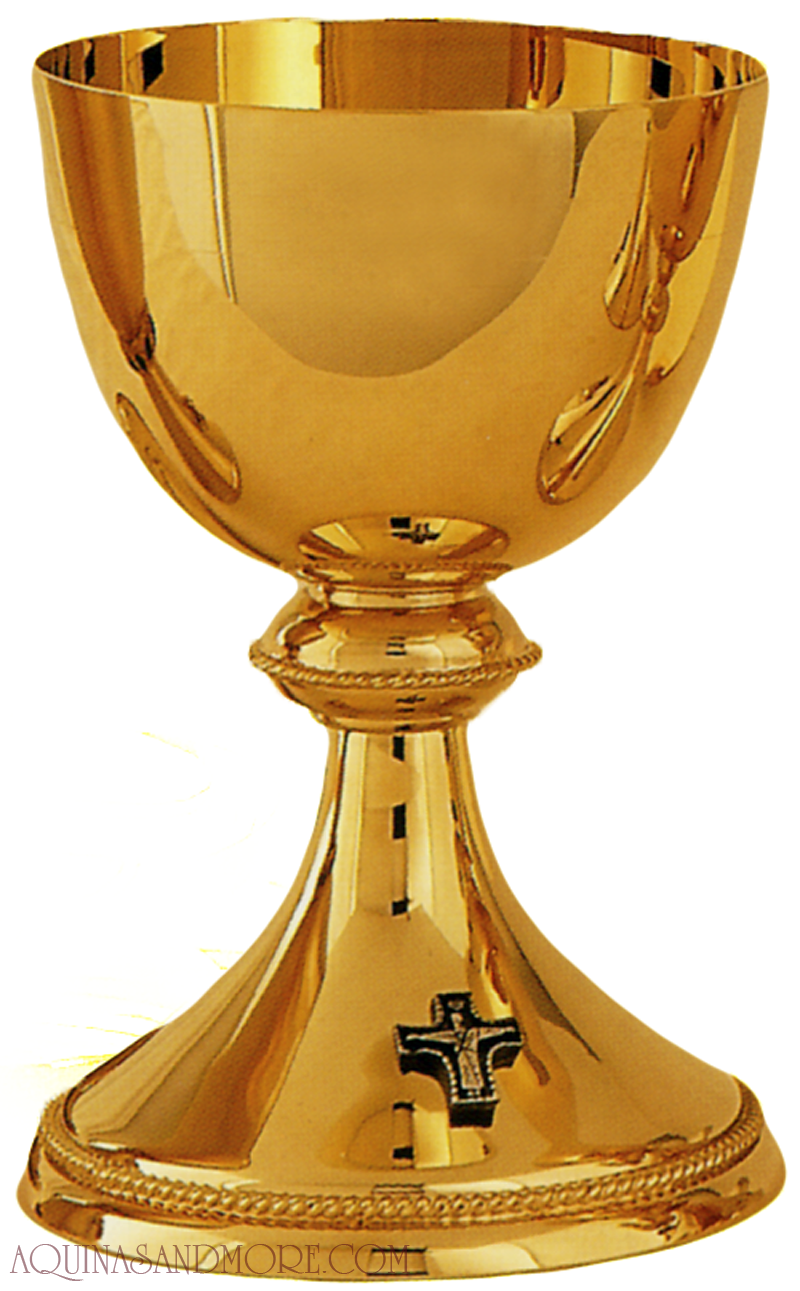
Of all that the Church practices, the most central example of this is the Communion service. This has always been true in the Church, the reduction of it to "merely a memorial" of Christ's sacrifice on the Cross is a relatively recent invention of Swiss Reformers from the 16th century. It has always been seen as expressing God's presence and conveying his grace to us in a manner that other rites do not. This is why abuse of this could constitute capital crimes according to the Spirit of God in relating to the Corinthians. The significance and power of Communion is such that it is no small matter to participate in serving it to God's people. Having been serving as a Chalice Bearer, I can say that the weight of it is not lost on me. Years of seminary classes and theological lessons are compressed within the moment that I hold the chalice in my hands and approach the nearest worshiper, preparing to offer them the "cup of Christ." At that moment, all that I've learned about God's grace, his habit of conveying his presence through material stuff, the history of the Church in celebrating his redemption together in Communion all come crashing over me. It's as though all of those concepts, lessons and truth could be compressed into a single moment and can be held in the hand and offered to another.

I liken this to a scene in "Iron Man 2" in which the character of Tony Stark spends time in his lab discovering a new element. For special effects, it's a rather impressive moment in the film in which Tony has the components of his research projected as holographic images before him, to be manipulated and controlled using his hands. In an instant of eye-catching imagery, Stark throws his hands wide to expand the view of his "element," filling the room with it's projected details in which he sits at the center. Turning around to behold it all, he basked momentarily in the discovery of it, then claps his hands together to once again reduce the image's size down to a single glow of light in his palm. Going from the exploded view to the singular view with the wave of his hand brings the whole reality of the element, which was far larger than him, into a compressed size that he can hold in one hand.


It is my favorite moment of the film (and occurs in the above clip at 3 minutes in) because of how it not only conveys the idea of sacraments, but also ministry moments in time as well. I've had plenty of instances like that when a quick event in ministry work seems to compress within seconds centuries of church history and doctrinal back-and-forth. All of this can happen when working in the Church during a worship service, and particularly during Holy Communion. I walk up to the rail to gently offer the cup to a Christian awaiting the Communion wine, easing it forward and reciting those comforting words to accompany offering this to God's people:

THE Blood of our Lord Jesus Christ, which was shed for thee, preserve thy body and soul unto everlasting life. Drink this in remembrance that Christ’s Blood was shed for thee, and be thankful.

In that intimate moment, it is the privilege of the Chalice Bearer to lean in close to them to ensure a smooth and clean motion holding the cup to the lips of people. Often it means being closer into worshiper's "personal space" than is even needed of the Presbyter who must walk by placing bread in Communion bread in their hands (as is his exclusive responsibility). Nevertheless, in that second of connection, it is not me they commune with, but Christ; yet in the mystery of the Church, they and I do connect in that setting. The vertical connection to God and the horizontal connection among people are both pictured in the holding of a chalice full of communion wine to a parishioner's lips. Centuries of history, tomes written on theology, scores of Biblical passages all compress into that brief two or three seconds with each person. Certainly Tony Stark's exploded molecular view of theological reality is compacted down into the single act of leaning in to offer the cup. Theology is held in one's hands at that moment.

Not long ago, I was in the midst of this work during a Sunday morning Holy Communion service, when I noticed a visitor at the rail who I did not recognize. As I followed behind the priest, who was placing Communion bread in the hands of kneeling Christians, I approached this man with the cup of wine. To my surprise, he motioned to me that he had already had bread and did not expect to receive wine as well.

Now I had read that during Medieval times the Roman Catholic Church had fanned the flames of controversy by refusing to offer communion "under both kinds," offering only bread to the people and not wine as well. The Reformation of the 16th and 17th centuries addressed this and rightly corrected it. Nevertheless, some Roman churches persist in using Communion as a means of sparingly offering God's grace because those approaching the rail should be more sober minded about it. Rubbish!! One dare not withhold that which Christ has freely offered and expect to escape his stern rebuke. I was at once both indignant that any had ever told this man that he could not have Holy Communion "under both kinds" and moved with compassion for him. How much had this practice taught him that God's grace is only partially offered to him? How much had he wondered about his worthiness to boldly approach the throne of grace with his petitions and prayers because of some Roman practice of keeping something back. ALL of Communion is meant to convey Christ's presence and grace to us as our hearts are caught into heaven in worship to "commune" with him where he sits at the right hand of the Father. I would NOT want to be on the receiving end of Jesus' displeasure at watching tangible, material, physical instruments of his own grace being withheld from people.

So there I was, offering the Chalice to this man that was not expecting to receive it. The exact exchange is important. He held up a hand and said, "thank you, but I had bread." Instantly my mind raced through my church history lessons to access a reason for which he might not expect this also. My response to him was, "it's ok. You can have this too." Of course, what I didn't say was, "and I don't care what loser told you otherwise!" Instead, I just smiled and offered God's grace freely to him. He beamed. He lit up like a man who had just been told he wasn't simply going to receive "part" of God's assuring grace that day, but ALL of it. Of course, I smiled wide as I leaned into him and offered him the cup. I felt a compressed version of the Reformation had occurred in those few seconds. Stark's molecular hologram compressed down and theology, centuries of it, could be held in the hands.

The Church has always recognized that the Gospel is communicated through symbol, sacrament and speech. Theology is not merely a mental pursuit. It is communicated through very tangible means sometimes, and even the realities of God's grace can be offered through sacraments offered and received in faith. In my duties so far, I've seen vast amounts of seminary training compressed into single moments, and events into the material, earthy "stuff" of worship elements. Indeed, God's still uses "stuff" to convey is presence and grace; and thus theology sometimes can be held in one's hands.

Sunday, May 22, 2011

The "Call" to Ministry

Resting in its charger, the pager looks like a rather innocuous device that potentially might *squawk* after it's initially turned on. There it sits, in the corner of the bedroom, quietly taking up a little four by five inch space on the desk you try to keep un-cluttered. For the most part, it remains quiet, allowing a blissful REM cycle next to your spouse. The pager may have even remained dormant all day as it was worn on the belt, going about the necessary business. But then sometime around 3:17 a.m., the high-pitched tone emits from the little black speaker nestled in the charger. Several sharp *beeps* ensue, followed by the dispatchers voice calling:

"Attention Fate Fire... Attention Fate Fire, need you enroute to...."

Most often the dispatcher was a woman, so her voice became familiar. Still in a dream-like state, you raise your head off the pillow, jolted awake by the pager tone. Hopefully, you shake your head clear fast enough to hear the remainder of her directions. For the chaplain, it was never expected that I would get to the station as quickly as the firefighters, or even attend every call. But I did listen to each one to discern whether this call might be one in which a chaplain would be of some help. On many occasions, I went anyway, whether or not I would be useful for victim support or rehab, simply because my beloved firefighters were having to be out on a call at this hour anyway... and at the end of the day, I'm first and foremost here for them. Nevertheless, I listen to the dispatcher voice describe the nature of the call: "structure fire." That's all I need to hear.

I hear those words and all ambiguity is gone. Whatever thoughts I might have had about letting them get that "downed power-line" without me, or investigating a carbon dioxide detector going off without the encumbrance of an extra body around, fade into adrenaline filled clarity. Someone is possibly losing valuable heirlooms tonight, or business property they've invested their money, sweat and soul into. At best, some already damaged property will require a messy overhaul to ensure no rekindles threaten even more. At worst, a family is losing a home; to think nothing of the unthinkable, yet very real, potential that loss of life could enter our experience before the Sun rises. In addition, my role is not merely to be present for them that lose so much anyway, but also (arguably mainly for), those that will spend themselves to the last ounce of energy (and sometimes beyond) attempting to save life and property.

Even if the structure is an abandoned barn, with no discernible threat to nearby residents or business, my beloved firefighters will still be up combating the blaze, fighting valiantly to "slay the dragon" wherever he may choose to appear. It is at those times when I want to be with them, to assure them of God's presence, to offer them cold bottles of water in Jesus' name, roll hoses for them or help them get the air pack off for some rest. I want to be with them to persuade them, if by any means I can, that God accompanied them on the call, rode with them on the apparatus and is present with them on the fire-ground. Put simply, when the pager goes off, it's a "no-brainer." The call has been issued for ministry to ensue, and I'm going.

For this reason, I've never been comfortable with the way we commonly speak of a man "called to ministry." What does that mean? Does the "calling" reside upon him like some sort of incurable virus?

Doctor: "I have some heavy news."
Patient: "What is it?"
Doctor: "Your blood work came back positive for "calling:" the virus that causes ministry."

Many an immoral, greedy and heretical man has reaped untold harm upon people simply by constructing ministries out of thin air, seemingly "deserving" of such influence because of the "calling" that is upon him, as if a self-declared "minister" may, by the authority of his own internal promptings, get in on the lucrative religion market. Because I am neither morally superior, not greed-less, the only protection extant for people (from me) desiring to be ministered to is that "calling" that comes from a legitimate need for one authorized to meet it from within a structured team. I simply must, for conscience sake, have the comfort of knowing that if an ecclesiastical "pager" goes off, the one "calling" is authorized to "yank me out of bed and into action." Without that type of official seal, I'd be just another curious intruder, messing up the fire-ground order (I'm speaking of the church, of course) without proper authorization to be there.

In addition, the "call" of the pager creates the vital connection between "caller" and "responder." Without it, I'm just a wandering annoyance looking for a place to be relevant, but without any true resources or backing. I don't agree with the common rhetoric concerning the "call" to ministry. A man may say that he's "called," but then I want to ask, "by whom?" "By God!" he retorts in self-assured indignation. "So say you," I counter, "but if God's communication patterns remain consistent (letting the Prophets, Apostles and many witnesses in on his little 'secret' regarding Jesus Christ), then it seems like he would 'call' in some tangible manner detectable by the rest of us in the Faith also. Take an antacid pill, dude. That 'burning in your bosom' is going to hurt somebody."

As for me, if the "pager" goes off, either by means of a request to teach in church or at college, or even the prodding of authorities over me in the Church to prepare for new levels of usefulness in her operations, I can at least say that I'm responding to being summoned. But respond I will, because such is the instinct of one remaining available for timely service. Of course, all of this use of a pager as an analogy for "calling" is made relevant because the dispatch tone truly is the "call" to ministry for a fire chaplain. Of all the "calls" to ministry I could hear in my life, none could ever be so obvious, and inducing a frantic getting dressed and rushing out the door at 2:48 a.m., than that pager issued to me by the fire department. In such moments, all other thoughts of slumbering comforts, personal schedules or inconvenience are eclipsed by the singular mission of persuading (with my presence) my beloved firefighters that, during their exhausting labors to save life and property, God was with them on "the call."

Monday, May 16, 2011

Faith over Certainty

Hebrews 11:1 reads "Now faith is being sure of what we hope for, being convinced of what we do not see." (NET). The verse is so often quoted that it can be among the most memorized in all of Christendom. The emphasis is often placed on being "sure" and "convinced," but not as much is said about "what we do not see." This is because so much is made of having "vision" in our culture, on "seeing" what's coming up ahead, detecting God's "plan" or discerning God's "will." The problem with that is that it seems to really marginalize the end of the verse: "what we do not see." If a thing cannot be seen, how then can one claim certainty about it? Oh sure, faith may be "convinced" of it, but it doesn't claim the same certainty as though it could SEE it.

In fact, if certainty is the standard, as though we could "see" these things, where is left room for faith? Certainty seems to have become so much of what we think is associated with "vision" that we even suggest that people just "have faith" in the same way. Therefore popular understandings of faith will tolerate no uncertainty. To entertain doubts about what is popularly believed is to "lose one's faith." In circles where faith is highly valued, the one with any doubts may find themselves in a silent minority. In essence, they must remain "in the closet," keeping their doubts to themselves. Otherwise, their faith will not be considered strong enough to receive that coveted of all titles within the fellowship: "edifying."

But over time, I've come to care less and less about whether I deserve the coveted "positive person" statue, and instead if I'm truly wrestling with matters of faith and doubt as I should. Oh this by no means excuses someone to suck the life out of the room when they enter. There's no reason to suddenly become a spiritual "Eeyore;" however, neither should one feel the need to artificially become the "Tigger" of the church either. Honesty with one's self is a vital component to honesty with one's God. Which leads me to my frequent maxim of faith:

Say what you know... not what you don't know.

The list of faith assertions I'm prepared to declare with great confidence has shrunk over time. I now assert fewer propositions, but assert them more strongly. By extension though, things that do not "make the cut," I've become more comfortable with saying, "I don't know... and neither do you." So many subjective assumptions become "received dogma" simply but the frequency of popular use. The everyday phrases thrown out regarding God's "will," God's "call" and God's "plan" all typically come from superstition more than Holy Scripture.

I'm prepared to assert a few things that I "know" (which are more likely than not found in the ancient Creeds), but I won't assert things that I don't "know."

---"You know this is God's will for you, don't you?".... No, I don't "know" that. I'm playing it by ear, hopefully with wisdom - which Scriptures say I should ask for.

---"You know that God has 'called' you to this, don't you?".... No, I don't "know" that. I'm remaining available to be used by the Church according to my skills, abilities and gifts that they perceive a need for.

---"You know that God has a 'plan' for your life, don't you?"....Perhaps, but since he has not revealed that "plan," it's fruitless to obsess over discovering it.

My doubts do not threaten my faith, they just corral it, clarify it, help me assert only reliable things. Please don't be upset if you hear me express doubts, even sharply in the face of adversity. I'm not punting faith, just trying to maintain a faith that won't look silly to me a few minutes later after I've regained the lucid ability to seriously think about what I just said. At those moments, I'd want to slap my forehead and think, "You dork. You don't know that at all. Why did you say it?" That's actually when a strong faith can emerge that, by it's nature, is really "faith;" not the grasping for certainty we often entertain that does not like that there are some things we "do not see."

Thursday, March 17, 2011

The Things that Attach and Corrupt

Sin is alive...
It has a will.
It eats.
It hates.
It spares no innocence; gives no quarter; honors no boundaries.
It remains ever hungry, and is never satisfied.
It has one instinct, and one instinct alone:

To attach itself to a host, and impregnate him with a creature that will feed on him... destroy him... and then attack everyone around him.

Sin has a metaphysical element, traveling across creation... across time... and across dimensions. It emits out like a wave, and passes through substance, soil and soul.
It's more destructive than a tsunami.
It permeates more than radiation.
It consumes more than Great White shark.
It's more venomous than a Cobra.
...more encroaching than darkness.
...more communicable than the flu.
...more blinding than cataracts.
...more intoxicating than Everclear.
...more irritating than a rash.
...more scalding than boiling water.
and more tactical than a chess master.

It's faster than a viper strike.
...colder than wind chill.
...sharper than a straight razor;
and meaner than a bully.

With sinister cunning, this creature eludes detection until it is close enough to pounce. All of its sensors reach out with mystical searching, seeking to find its prey and perceive its weakness. It crouches at the door (Gen 4:7) of the dark room. Lying in wait, it's patient to await just the right moment to launch through the air and land on the unsuspecting. As the legs extend out to secure a grip, its tail wraps around the horrified victim. If the victim cannot resist well at this point, the creature attaches firmly to the face so as to implant its destructive seed down their gullet. If they can resist, the fight is violent and erratic. So determined is the muscular, spider-like alien to affix itself securely to the new host, that removing it takes the timely and persistent help from friends that care deeply enough to get their hands on the thing and pull with all their might. In fact, unless the quick assistance of beloved associates intervenes, the struggle may be short lived. This creature is strong, agile and wiggly.

Sin, a living thing, does not rest until it attaches itself to the child of God, and lays in them the "seed" of a creature than can destroy them from within and will terrorize those around them. If their family, their friends and their church doesn't step in with loving vigilance, Sin is often too strong for them to fight alone. This is why secrecy is such a friend to Sin, and confession is so harmful to it. Through transparency and confession (James 5:16) the community becomes aware that quick help is vital. In addition, Sin's ability to affix itself to the soul is weakened by confession as well. It's a great mystery, but the very things one would want to keep to themselves out of shame must be shared with others to overcome.

How unfortunate that the historic practice of confession fell out of favor with Protestant traditions. Psychologists and counselors has their use, to be sure, but they MUST be viewed as secondary to the timeless necessity for an officer of the Church declaring, after hearing your confession, "God offers forgiveness to the penitent. Go in peace." This "creature" is determined, and the Church must be more so, if indeed it loves the sinner seeking release from it.

Sin is alive. It's seeks to dominate, impregnate, destroy and multiply. The help of those quick to aid is vital. Though God has granted the Believer great abilities, seemingly absent from those is the strength to fight away the "creature" in isolation.

Monday, July 26, 2010

The Right Religion

Evaluating our religious trappings and expressions can be a precarious process that threatens to, in typical vampire fashion, suck the lifeblood out of our meaningful worship moments and gatherings. All the same, evaluation is so vitally necessary precisely because deviating from good practice will forever remain easily instinctive. While I have already broached the subject of praxi fide before, some of that warrants repeating here. Belief and practice are inextricably linked, and both communal and personal expressions of them are wrapped up in what can best be summarized as "religion." I get so tired of the foolish statement often uttered by well-intentioned evangelists, "It's not a religion. It's a relationship." Imagine attempting to apply that type of false dichotomy to marriage, suggesting that a healthy relationship is possible without ANY outward expressions of that relationship manifested in the 'rituals' of quality time, giving gifts, physical touching, words of affirmation or acts of service (borrowing from Gary Chapman's The 5 Love Languages). It's not a choice between a relationship or expressions of relating. It's relating through expressions of a healthy relationship. So it is with our most important relationship - our relationship with God; and practicing a right religion will be symptomatic of a healthy relationship with him.

"Religion" can be defined as: the service and worship of the divine or supernatural through a system of attitudes, beliefs, and practices maintained within a given culture or community. Such a definition is helpful, but leaves us with the notion that if there is indeed a 'received' system "maintained within a given culture of community," it would not only be necessary to identify the various spectra of communal and personal expressions of that "system," but also ways of deviating from that system as well. Thus, in evaluating observable religious practice, two axis can be offered to form a "grid" for 'plotting' religion in relation to a community or culture. A horizontal axis would be the 'normative' vs 'deviant' continuum, and the vertical axis would form the 'official religion' vs 'popular' (or personal) continuum. Click to image to the right to expand it. In this manner, we can identity where a practice falls in relation to 'received' practice in the culture, in relation the religious authorities appointed to facilitate or conduct the religion, or in one's own personal piety. Along with this graphic, some other definitions may also be helpful.

What is meant by these 'types' of religious practice?

Normative religion: adhering to the accepted practice and beliefs received and codified within a given community (i.e. Sacred Scriptures or cultural consensus).

Official religion: practice and beliefs conducted and/or required by authoritative leadership (i.e. priestly or royal figures).

Popular religion: personal piety of the private practitioner influenced by criteria decided upon by the motives and needs of the individual.

Deviant religion: operating outside acceptable normative parameters related to religious thought and ritual.

These categories help us to organize and make sense of the wide diversity of religious expressions evident in ancient Israel, as well as understand how their history offers beneficial lessons for us today. It also helps us to evaluate religion even in our present day with regard to our own Christian context. For example, a popular idea might have arisen among some Christians that differs significantly from what is taught at the official level of professional theologians within a given tradition. Likewise, certain doctrines and practices can be acknowledged as having been 'received' and codified by all Christians everywhere, thus making them the norm from which someone might deviate.

My contention is that any culture's religious expressions fall somewhere into this rubric, but of course in my own case, it is applied specifically to Christianity. Therefore, the 'norms' of Christianity are determined by what the Apostles and church fathers showed to be the clear teaching of Holy Scripture. This creates the normative Christian religion that official leadership is tasked with leading people to follow. At the popular level, it remains the responsibility of each believer to follow the normative religion prescribed by orthodox authorities. It is sobering to realize that leaders can deviate from the accepted norms, and lead others to do so as well. Not only this, but individuals can, at the popular level, deviate from official orthodoxy also. Certainly any pastor might find it disconcerting to discover what superstitions are entertained by those regularly exposed to his preaching (and thus should know better).

For ancient Israel, all of these categories are well represented in their history. Official normative religion is well demonstrated by the orthodox worship conducted in the wilderness Tabernacle or at the dedication of Solomon's Temple in Jerusalem. Yet official deviance is shown through Israelite kings following after the neighboring Canaanite gods and, by virtue of their royal office, leading the rest of the nation to do the same. While normative religion is easy to experience through the popular psalms, hymns and poetry of David, Hannah and others, popular deviance is detectable in the household idols used in the period of the Judges.

The personal ramifications are weighty. Having become confident that authorities over me are leading in and facilitating normative Christian religion, it falls to me to follow it and adhere to those norms at the popular level. It is possible that the leadership could deviate from orthodoxy in some obvious manner (as with the Episcopal Church; ECUSA), thereby forcing me to find new leaders that follow Christian norms. However, so long as my leadership is officially normative, my popular and personal piety must align with it. Some in our culture will champion one's right to choose their religion, but it seems more healthy to exercise that choice to adhere to right religion. After all, it expresses my relationship to God, so there is nothing more important to be right about.

Wednesday, July 21, 2010

That's Sacred to Me

Growing up, I heard two contradictory messages from Christian authority figures all around me, though I didn't realize it at the time.

1. God is everywhere and with us all the time. He doesn't need special rituals or spaces to meet with us (as was supposedly the dominant reality of Jewish religion in the Old Testament). "We're not like those Catholics," I was told, "who need rituals, robes and ornate buildings to worship. We don't need all that 'extra' stuff." Buildings, things and job positions aren't particularly "special" to God.

2. "Don't run in church!"... "Don't treat your Bible like that!" ... "Dress in your 'Sunday best'"... "Support your pastor. He's a 'man of God'."

You can see the conflict. There was an overt anti-Catholicism in the Baptist tradition that sought to reject 'elements of the sacred' while intuitively practicing them in many respects. Over the years though, I've come to discover that Protestant traditions rightly maintain this unacknowledged instinct because it has such deep roots among the populus Dei ("the people of God" for all time). What is necessary is not to deny these 'elements of the sacred,' but instead to plainly identify them, properly engaging them in worshiping the Lord. I offer here five categories of "the sacred" that the people of God naturally use in the lifestyle of worship:

  • Sacred Times
One of the most easily acknowledged of these categories is the notion of specific times 'set apart' to God for worship or his particular use. The 10 Commandments includes this with "Remember the Sabbath day to set it apart as holy. For six days you may labor and do all your work, but the seventh day is a Sabbath to the LORD your God; on it you shall not do any work, you, or your son, or your daughter, or your male servant, or your female servant, or your cattle, or the resident foreigner who is in your gates" (Ex 20:8-10). Thus the notion of sacred time is introduced in the Old Testament, and carries forward into the New Testament as early Christians gathered on Sunday to commemorate the first day of the week when Christ arose from the dead. Therefore, the Christian Sunday replaced the Jewish Saturday ("sabbath") as the day of the week set apart to the Lord specifically to worship him and enjoy his provision.

However, 'sacred time' was, by no means, restricted to merely a day. Sacred holidays (feasts) punctuated the calender to create the occasional party 'to the Lord.' In addition, even times of day were designated for 'morning and evening sacrifice.' Sacred time is setting aside particular amounts of time for worshiping the Lord and enjoying life with him.

  • Sacred Space
Though not listed specifically in the Decalogue, the element of sacred space remains ever present throughout the Bible. Though it's more easily observed in the Old Testament (i.e. Moses removes shoes on 'holy ground,' Jerusalem as God's 'holy city' and the Temple as the 'house' of the Lord), the New Testament makes no effort to counteract this paradigm. The early Church appears to have understood this level of their continuity with the ancient faith of the Israelites, developing healthy appetites for the 'sanctuary' as designated space for communal worship. The "Don't run in church!" admonishment of the Baptist church betrays a heritage beholden to the ancient Church catholic. What's more? The front of the church building differs from the rear of the 'sanctuary' (i.e. auditorium or 'worship center' for mega-churches). Even if horseplay is tolerated among children after service hours, they still are not allowed to rough-house on the stage, around the pulpit or across the communion table. People of faith have an intuitive sense of 'sacred space' that suggests to them, "the Lord communes with me there in a different manner that he does elsewhere."

  • Sacred rites
It is only natural that protocols and procedures are in place for interacting with the Divine that acknowledges their superior place over the worshiper. This acknowledgment is essential to demonstrate reverence and appropriate respect to the deity one believes is being worshiped. Obviously, one can get around this by simply not believing that a deity is present or listening, but this amounts to a functional atheism unacceptable to the devout. Communal worship in the Old Testament is the very model of rites and rituals all crafted to reflect the holiness of the God being approached through the system of sacrifices. Though all of these would not be exactly duplicated in the New Testament, echoes of them are found in such NT admonishments to "do everything in a decent and orderly manner" (1 Cor 14:40) and worship descriptions as "They were devoting themselves to the apostles’ teaching [suggests a creedal confession of faith] and to fellowship, to the breaking of bread [suggests sacramental communion] and to prayer [lit. the prayers]" (Acts 2:42). Even church traditions that claim to be "non-liturgical" demonstrate this principle in how accepted practices naturally emerge as facilitating worship during the gathering of the faithful.

  • Sacred objects
The tradition is long and obvious that God uses stuff as instruments of his presence and power. Whether it is Moses' staff during the Exodus story, the Ark of the Covenant or the hem of Christ's garment through which a woman was healed, objects have been designated by God throughout redemptive history to convey God's 'localized presence.' The fear of overdoing this instinct into a quasi-idolatry should, by no means, retard the tendency to continue what God has instituted in ancient times. If Paul's quotation of Habakkuk that "the righteous by faith will live" suggests a continuity of faith among the Faithful of all time periods (cf. Rom 1:17; Hab 2:4), then God's use of sacred objects to convey his presence among his people is no less appropriate today than it has ever been throughout time. Thus, abusing sacraments in the NT can carry similar consequences to unauthorized contact with the Ark of the Covenant in the OT (cf. 1 Cor 11:27-30; 2 Sam 6:6-7). One appropriately demonstrates reverent care for those objects used for worship today (i.e. Bible, crosses, communion ware, even worship garments) knowing that reverence employed in handling those objects reflects one's reverence before God.

  • Sacred offices
Within a given community, there is always a clear necessity for designated people, set apart and skilled, to facilitate the communal worship rites. This is not merely restricted to the prophets, priests and Levites of ancient Israel. Presbyters, pastors and teachers are listed among the "gifts" God gives to the New Testament covenant community as well. The office of "Apostle" holds special status as the first of Jesus' followers who are trusted with accurately and effectively spreading his message. Thus, it remains necessary for clergy to be ordained by someone that was ordained by someone that was ordained by someone [etc....] ordained by an Apostle and trusted to succeed them ("apostolic succession"). Even now, 'holy men' are consecrated within a given religious community, and recognized as qualified to lead the community in their accepted rites. Being 'set apart' as holding a sacred office, these individuals fulfill an intermediary function, assisting worshipers in connecting with God, reflecting the ultimate and complete manner this function is carried out by Jesus Christ.

These 'elements of the sacred' are clearly evident in the Biblical record, and are reflected in modern Christian practice as well. The most legitimate Christian practices embrace this heritage and seek to maintain the healthy intermingling of orthodoxy and orthopraxy. In addition, we have not even addressed here the concept of 'scared people,' that renders the populus Dei as the official residence of the living God (sacred space), with a lifespan dedicated to God (sacred time), who is his instrument of presence and power (sacred objects), who are invited into his courtly presence through royal protocols (sacred rites) and must bear his image and represent him to the world (sacred office). This notion of sacred people would thus render all sin a defilement of the sacred.

I grew up in a tradition that offered contradictory messages about 'the sacred.' I now operate in a tradition that maintains better harmony regarding these. In my opinion, all Christians would benefit greatly from acknowledging their instincts toward the sacred as given by God, and that those instincts, while needing parameters and direction from Holy Scripture and the wisely authoritative fellowship of the Church, are ignored at our own peril.

Wednesday, June 23, 2010

What's the "Calling" in life?

One of the issues that contributes a great deal to "teen angst" is the concern over "What do you want to be/do when you grow up?" The process of selecting a profession that will be both personally fulfilling and financially sustaining is a daunting task that few high-schoolers are up to. It is, therefore, of little help that so many influential voices surround them regarding what they ought to do with their life. The malaise of messages they imbibe while braving the gauntlet often labeled "finding yourself" are by no means harmonious. Familial opinions may clash with the youth's own internal proddings, or they may echo them. In any case, the young person can by no means ignore the thoughts of their surrounding peers or parents when considering the career path.

Hopefully, all of the hard work of personal discovery pays off as choices are made regarding vocation paths and education strategies. Nevertheless, when engaged in that path, the individual must perceive that it is a course they have chosen. However, the truly autonomous choice is somewhat of a misnomer. Myriad factors come to bear in the process of decision making, and ambient conditions of peer pressure and familial approval cannot be fully discounted. On the contrary, so varied are the influential components on one's choosing of a life course that it remains highly problematic to identify them all. As a result, many do not even attempt to do so. Instead, the kaleidoscope of shades that color their decision are clumped together and summarized with a nebulous label: "calling."

This term ("calling") has come into such popular use that the fact that no one truly knows what they mean when they use it is, by no means, a deterrent from using it with dizzying frequency. It's uses range from the relatively benign compliment "You missed your calling" (given when one supposedly observes exceptional skill demonstrated in another), to the more sinister source of teen-angst "You must discover your calling" (saddling the youngster with the heavy misconception that there might be one thing they can do in life). In any event, "calling" is meant to convey the supposed marrying of aptitude and appetite as regarding one's vocation. It can be used in a comparatively harmless manner, suggesting that one's "calling" should reflect both high aptitude AND high appetite activity, but in religious circles it can take on a very different connotation.

The propensity of the religious sub-culture to "punt" to the work of God as a sort of universal "fudge factor" cannot be overstated. Anything for which I'm unwilling to take the time to explain, I can simply invoke how "God works in mysterious ways" to end the conversation. This instinct is not entire misplaced, for the life of faith acknowledges how frequently God works through seemingly natural processes (also labeled "Providence" in some literature). Nevertheless, this same instinct can be abused to infuse certain inexplicable choices with Divine authority. In few cases is this more evident than with the manner that minsters describe themselves as "called of God." Instead of simply acknowledging the choices they made, and that their aptitude and appetite converged in a ministerial career, the choice to pursue a career in ministry is suggested to have been a response to a "Divine call."

This language can have the positive effect of helping the minister weather tough moments in the career, where setbacks and disappointments can test resolve. However, at the other end of the spectrum, it can have the destructive effect of keeping someone locked into that arena that should not be there. It is one thing for a man to endure hardships in a vocation because he feels "called" to it. It is another matter altogether for a man to remain in a vocation he not well suited for because of the guilt over potentially ignoring his "calling." Thus the whole language of "calling" seems hardly worth it's destructive potential. Surely God is not offended if a man who he "calls" admits that he really wanted to become a minister. But what untold pain ensues when a man that should not be in ministry stays at it because he perceives himself "called by God?"

This misplaced and pious language borrows its terms from Biblical terminology used less than a dozen times in Pauline literature (Greek-kaleo meaning "to urgently invite someone to accept responsibilities for a particular task, implying a new relationship to the one who does the calling — ‘to call, to call to a task.’"). Most often the phrasing of "calling" or "called" referenced God's drawing of someone to salvation through faith in Christ - having little to do with vocation choices or service in the Church. Nevertheless, because the term is found in the Bible, this gives license to use it, in popular religion, to blame my career choices on God more than on my own desires or the influence felt from friends and family.

For years I had labored under the assumption of having been "called" to the ministry. Many education and ecclesiastical choices were made in light of this assumption. However, now, after a considerable time of reflection, it is more plainly evident that the various ambient influences that came to bear should have been better identified. Ministerial choices were made with considerable attention to how family and friends found it laudable and praiseworthy. In an evangelical sub-culture, it is considered that if someone is truly spiritual, they will seek to "devote their life to the service of Christ" (this is code language for pursuing a religious career). As much as I revered my father, there was no one he revered so much as the local pastor. If a young man wanted to pursue a career that pleased that father, the choice was obvious. In addition, having various friends in the evangelical sub-culture who also thought a ministry career to be more respectable than any other pursuit, peer approval also played a role.

Can it be forcefully asserted that God played no role in this? By no means. To the extent that Providence can be credited for life lessons, God is appropriately thanked for life events that have proven beneficial. Was ministerial training and service totally contrary to my desires? Not at all. Indeed for one who enjoys teaching and training others, such aptitudes can find fulfilling expression in many careers (ministry included). But was I "called of God" to ministry? This language seems so meaningless now. I was once quite convinced I was "called," but had also failed to account for the various factors that had influenced my choices. So now, it seems far more responsible to merely assert that one is "called" to be conformed to the image of Christ - and some may choose careers of training other people in that process (which I did for a time).

But that's not good enough for some. It was recently posed to me that if I once was "called," to rebel against that "calling" now is sin. THAT'S SICK! The man that suggested that to me is one who I have some respect for, so I didn't exclaim to him what was blaring in my head at the time ("You pulled that out of thin air!" - censored, of course). What great pressures are heaped upon some for suggesting that their career choice is no less vital to the Church than when Jesus "called" his disciples to follow him. No, it is far more helpful to simply acknowledge one's choices, along with the various influences impacting that decision (Yes, religious zeal is a legitimate influential factor; so long as it is acknowledged as part of one's own choice), rather than to "punt" to the ambiguous language of "calling" that, while shielding one from others questioning the choice, serves to misplace responsibility for the choice. God didn't make you do this. You wanted to. Now admit the various reasons why doing it brought you fulfillment.

For me, Christian ministry brought me fulfillment because I enjoy watching people develop. It gives me pleasure to see people learn, and through that learning be better equipped to advance in their pursuits. In the Christian life, "advancement" means to be more conformed to the image of Christ. But for the same reasons I found fulfillment in ministry, I can easily find it elsewhere in academia as well. It's better to simply admit this than to maintain the unhelpful language of "calling." If a minister I respect speaks of being "called" to the ministry though, I won't try to refute him. I'll simply think to myself, "actually, you pretty much chose to do this. You're good at it. There was an opportunity to do it...and we're all the beneficiaries of your choice." May we all take more responsibility for our choices, identifying the various motives we bring to the table in making our choices, so that, while Providence can be credited for some good choices, God won't be blamed for bad ones.

Saturday, January 9, 2010

What do you Mean when you Say, "Equal?"

My recent examination of issues related to women performing combat ops in the U.S. military was actually part of a much broader subject of how one views the sexes, and what the differences between them means for society. Certainly no one denies there to be any difference between men and women. At the very least, physiological differences are acknowledged, even if no others are admitted. However, in conversing over the implications of differences beyond mere anatomical features, some terms must be agreed upon in order to advance the dialogue. The following is an explanation of the terms I have found helpful for discussing the subject:

Egalitarianism - This view holds that the sexes are equal in value, and that this equality has rendered further differences (beyond mere physiological features) to be largely irrelevant. Functions of domestic and societal roles are by and large culturally conditioned. This translates into a functional interchangeability between the sexes as it relates to responsibilities in the home and in society. Domestic roles or occupations outside the home can be pursued by either sex, for there is no rationale by which any role would be considered out of reach, or inappropriate for one or the other. Leadership in the home is the realm of either sex, or it can be shared between the spouses. The egalitarian view would not find a legitimate reason for assigning leadership responsibility to the mother or the father. Equality has rendered traditional roles archaic. Tradition is viewed with suspicion because of the manner in which one sex has unfairly dominated the other in history. Societal evolution and modern enlightenment requires that people progress beyond such paradigms of "inequality." This can be summarized as undifferentiated equality - no different roles for the sexes in home or society can be legitimately entertained because of the equality of the sexes.

Some examples of how this outlook toward humanity has been applied are roles of leadership in church, the home or even military service. The traditional domination of some societal or domestic functions by men is viewed as the unenlightened inequities of yesteryear. In Christian circles, this is seen as the trajectory of biblical ethics made evident by the Apostle Paul's assertion: "There is neither Jew nor Greek, there is neither slave nor free, there is neither male nor female–for all of you are one in Christ Jesus" - Gal 3:28. Egalitarianism is often applied to traditional roles of authority, but is demonstrated also in the proliferation of woman in other roles traditionally reserved for men because of their particular demands (i.e. police, firefighter, military, etc.).

Complimentarianism - This view holds that the sexes are indeed equal in value, but that the differences between them are significant for understanding created purpose. The differences between the sexes "compliment" each other to complete the whole picture and potential of humanity. The differences are not seen as impediments to equality, but instead are to be celebrated in the quest to fulfill the unique benefits of manhood and womanhood in the home and society at large. Men, fulfilling roles seeming to have been particularly assigned to them by creation and history, also champion the necessity and value of women doing likewise. The rationale for these particular roles are taken from both religious texts and historical precedent, but by no means retards the mutual admiration the sexes have for one another. Men fulfill responsibilities that seem "delegated" them to by God, soberly considering the weightiness of these functions, while admiring the particular and vital functions "delegated" to women that they are uniquely gifted to perform. In this manner, neither sex desires to be the other, for they extol the necessity of the opposite sex while embracing the functions of their own. Therefore, this view can be summarized as differentiated equality - the different roles "assigned" to both sexes are equally valuable precisely because of the equality of both sexes.

Some examples of this are in those roles that traditionally have found both men and woman dominant in them (religiously, domestically, socially, culturally, etc.). The folly has been in the slow devaluing of female-dominant roles, forcing woman to seek male-dominant roles to feel equal. The specific applications of the complimentarian model is tricky, for the Bible seemingly addresses differentiated equality primarily with regard to spiritual leadership in the community of faith (be it a home or a church). For this reason complimentarians see the role of spiritual leadership falling normatively upon men (as a burden of service more than a privilege), meaning that among the unchanging qualifications of a pastor are that they be male (ironically, while complimentarians see the role of pastor falling only to men, they have no problem with women performing the comparatively secular roles of President of the United States or British Prime Minister).

Chauvinism - This view is seldom admitted to because so few circles can be found in which it is socially acceptable in western culture. Rare is the man (if they can be found at all) that will confess their chauvinism outright. Instead they will simply speak as though women are inferior in various and sundry ways, that their influence has weakened society and that their contribution is negligible compared to the troubles associated with accommodating them. To this brand of male, women are necessary for sexual gratification and the bearing of children (oh, and throw in some domestic duties for good measure), but little else. They truly do not find women to be of "equal" value to men, but instead see women as functional necessities that must be managed by masculine power. Differentiated inequality best describes this position. To imagine women barefoot, pregnant and in the kitchen is a little impractical; since without at least some comfortable shoes to protect her feet, her life of service to him could be interrupted by injury.

Feminism - This view has common ground with chauvinism in that it also holds the opposite sex to be inferior. The ills perpetrated on human history and current society are entirely attributable to male abuse. For this reason, men are seen as a necessary evil for conceiving children, but it would be preferable for medical technology to find an alternative to the traditional method of egg fertilization. Women are superior in their capacity for virtue, with men being more prone to vice. Their macro analysis of the culture finds that man must be progressively marginalized for society to evolve. For this reason women not only can perform all roles traditionally assigned to men, but can most assuredly execute them better. No difference in role is considered because all roles are better filled by women than men. For this reason, feminism is the view of undifferentiated inequality.

Ironically, the feminist would acknowledge there exists roles that only women can perform, but would not acknowledge the existence of any roles that only men can perform. Mothers are absolutely necessary for child rearing, but fathers are an unnecessary luxury. A woman in political leadership can supposedly relate to all people, but a man in the same position is said to be unable to relate to women. A woman who preaches supposedly reaches a broad audience, but the male preacher is said to easily alienate the women in attendance.

These four views fall on a continuum (borrowing common terms of "right" and "left" to connote socially conservative and liberal trends respectively (click to view larger image):

Along this line chauvinism falls to the "far right," while feminism lands on the "far left." The middle ground is occupied by complimentarianism and egalitarianism in that they share the assertion of equality between the sexes. The continuum is necessary not only for the sake of a visual aid, but also because clear lines of demarcation separating these categories can be very difficult to discern.

Some that are called "feminists" are actually egalitarians. They are desirous of equal rights for women to vote, receive promotions based on their merits and achieve unfettered success in the areas they pursue, but do not actually view men as inferior to women. For this reason, many men are egalitarians that mistakenly call themselves "feminists." They believe in undifferentiated equality, and champion women participating in any role they choose, regardless of how historical traditions have addressed a particular issue.

To confuse the matter further, many complimentarians are accused of being "chauvinists." Because the egalitarian (to say nothing of the feminist) cannot accept a category of differentiated equality, the complimentarian's assertion that the sexes can be both equal and designed to fulfill different roles is seen at best as nonsense, and at worst as promoting inequality. To counter this the complimentarian strongly asserts differentiation, which sounds like chauvinism to those "left" of the center. However, the complimentarian understands that there still exists those to the right of them on the continuum. Real chauvinists still populate some religious and secular circles alike. They can be detected in church, in seminary or in any other gathering where they feel safe to share their true feelings about women. Knowing that chauvinists both believe in the inferiority of women and make life much more difficult for them, complimentarians bristle at their continued existence. Seeing the equality (albeit differentiated) of women as a cause worth fighting for, complimentarian men challenge chauvinists' perceptions and seek to limit the damage they can cause.

Parenthetically, the men of my church are complimentarian in that they appear to champion differentiated roles for the sexes, but will not countenance a chauvinist. Never has a single critical word been spoken at The Pipe Club concerning wives, for indeed it seems likely that the men present to hear it would, rightly indignant, set upon the erring brother with strong rebukes for his folly. Such reactions were observable from seminary professors who often so strongly asserted the value of the feminine influence in the Church that they seemed almost egalitarian to me. When I asked them if they were, their response was, "No. I'm complimentarian in my outlook of humanity. I'm just reacting to the chauvinist jerks that still seem to slither into this school now and then."

As a complimentarian, I'm not above personalizing the issue, seeing egalitarianism as devaluing roles that my wife (as a woman) is uniquely designed to perform, and chauvinism as devaluing her altogether. The egalitarian, I simply want to help gently correct their folly. The chauvinist, I'd like to correct not quite as gently.

Theologically, chauvinism and feminism share a common heresy: the belief in concentrated depravity. The effects of the great fall of humankind are universal. No one is exempt from the need for a Savior and to be redeemed from the effects and consequences of sin. The depravity of man touches all and influences all: this is the classic doctrine of "universal depravity." No one is more or less in need of saving than anyone else. We're all crooked deep down. The chauvinist sees the female as experiencing more of "the Fall's" degenerative effects. Consequently, they see the world as better managed when the negative influence of women is marginalized. Likewise, the feminist views the male similarly. Both see depravity as more "concentrated" in the opposite sex than in their own. This is also the root of racism: the intuitive assumption that the depravity of man is more concentrated in another race than in one's own.

Dismissing chauvinism and feminism for the gross errors that they are, a civil conversation should ensue between the remaining categories since both egalitarians and complimentarians agree on the equality of the sexes. Where they diverge is whether the differences inherent in those sexes translate into differentiated roles for certain spheres of responsibility in society. Will the egalitarian believe that the complimentarian they're conversing with is NOT a chauvinist simply for asserting differentiated roles? Will the complimentarian extend the courtesy to the egalitarian they're talking to NOT to assume that they're a rabid feminist simply because they desire undifferentiated roles? Civility is a prized condition for these conversations. If we could agree on some terms with which to have the conversation, that might go far in achieving a dialogue beneficial to all.

In the meantime, it is truly difficult to know what someone means when they say they strive for "equality." The feminist says they desire "equality" for women, but in truth likely sees the superiority of women far better (since men are indeed inherently inferior). The chauvinist speaks of "equality" for women in that they should also be allowed basic human services (the servant to the male must be kept fully functional after all). The egalitarian calls for "equality" between the sexes, confusing value and function, and desiring interchangeability between them (since some roles seem more important that others, denying a woman any of the more "important" roles is to perpetuate inequality). The complimentarian, however, sees "equality" of value among diverse functions (both mothers and fathers are equally necessary in their unique roles), and roles that seem gender specific are to be celebrated for demonstrating the necessity of either sex... This is the way the world best works.